

Quickstart — your first run#
Goal: load a scenario, run it, and see a result — in under a minute, with one zip already shipped with the repo.
If you have not installed the package yet:
pip install jupedsim-scenarios
Then run the cells below in order.
1. Load a scenario#
A scenario bundles the walkable geometry, agents, journeys, and solver settings. quickstart.zip is a small square-room scenario shipped with the repo. load_scenario also accepts a ZIP exported from the Web-Based JuPedSim editor, a directory with *.json + *.wkt, or a single self-contained JSON file.
import logging

logging.getLogger("jupedsim_scenarios").setLevel(logging.WARNING)

from jupedsim_scenarios import load_scenario

scenario = load_scenario("../assets/quickstart.zip")
print(f"model: {scenario.model_type}")
print(f"max simulation time: {scenario.max_simulation_time} s")
model: WarpDriverModel
max simulation time: 300 s
2. Run it#
run_scenario returns a ScenarioResult with summary metrics and a temporary SQLite trajectory file.
from jupedsim_scenarios import run_scenario

result = run_scenario(scenario, seed=420)
print(f"evacuation time : {result.evacuation_time:.1f} s")
print(f"agents evacuated: {result.agents_evacuated} / {result.total_agents}")
evacuation time : 31.2 s
agents evacuated: 104 / 104
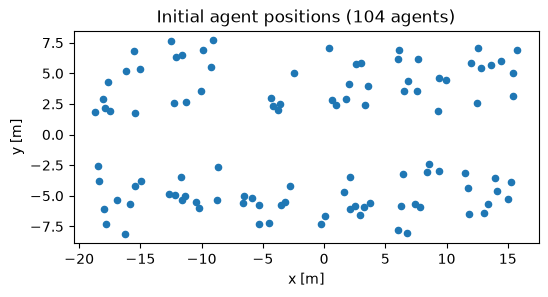
3. Pull the trajectory and plot one frame#
trajectory_dataframe() returns a pandas DataFrame with one row per agent per recorded frame. The schema is compatible with pedpy for downstream analysis.
import matplotlib.pyplot as plt

df = result.trajectory_dataframe()
frame_zero = df[df["frame"] == df["frame"].min()]

fig, ax = plt.subplots(figsize=(6, 4))
ax.scatter(frame_zero["x"], frame_zero["y"], s=20)
ax.set_aspect("equal")
ax.set_title(f"Initial agent positions ({len(frame_zero)} agents)")
ax.set_xlabel("x [m]")
ax.set_ylabel("y [m]")
plt.show()
4. Clean up#
The temporary trajectory file is not removed on garbage collection. Call cleanup() (or wrap the run in try / finally) so long notebook sessions do not accumulate gigabytes of SQLite files.
result.cleanup()
1
Where to next#
Concepts — the
Scenario/ScenarioResult/SweepResultlifecycle.Choosing an entrypoint — when to use
run_sweepvsrun_sweep_from_factory.Bottleneck tutorial — a guided tour with sweeps and model comparison.
Troubleshooting — common pitfalls and fixes.